On July 8, 2025, the Denver Nuggets and the Brooklyn Nets completed an offseason trade that reshaped both teams’ cap outlooks. Denver sent Michael Porter Jr. and an unprotected 2032 first-round pick to Brooklyn in exchange for Cameron Johnson. While the player movement drew attention, the more consequential story lies in how the deal repositioned each team under the new CBA.
Denver’s Cap Context Before the Trade
Entering the 2025 offseason, Denver was operating slightly above the first apron, with long-term money concentrated in Nikola Jokić, Jamal Murray, Aaron Gordon, and Michael Porter Jr. Under the new CBA, teams above the first apron face meaningful limitations, including:
- Reduced trade flexibility
- Inability to aggregate salaries in trades
- Restrictions on taking back more salary than sent out
- Limited access to certain exceptions and sign-and-trade mechanisms
Keeping the roster unchanged would have effectively locked Denver into an apron-constrained structure, limiting its ability to add depth or make meaningful in-season adjustments around its core.
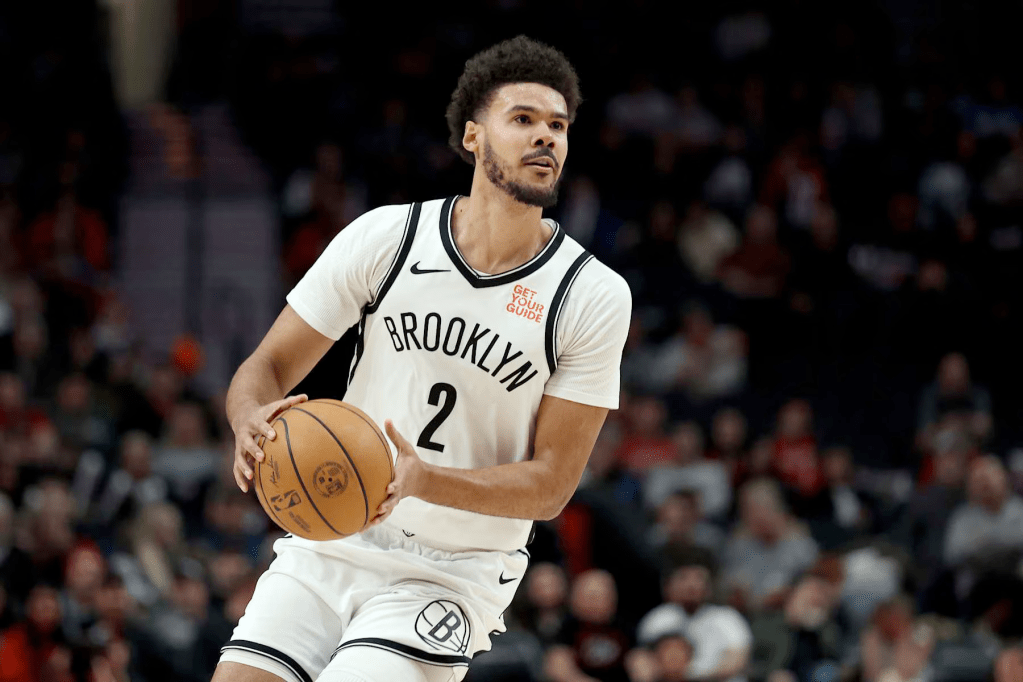
Cameron Johnson as a Financial Fit
Cameron Johnson’s appeal to Denver was less about replacing Porter Jr.’s scoring output and more about contract structure and optionality. By swapping MPJ’s deal for Johnson’s, Denver reduced its overall team salary and created breathing room below the first apron. That shift reopened several CBA mechanisms that had previously been unavailable, restoring flexibility without requiring a full teardown.
From a cap perspective, this trade gave Denver meaningful flexibility. Prior to the deal, the Nuggets were roughly $65.6 million over the salary cap and about $1.2 million over the first apron — which would have limited their ability to add via exceptions. Swapping **Michael Porter Jr.’s larger salary (about $38.3 M in 2025-26, $40.8 M in 2026-27) for Cameron Johnson’s more manageable contract (~$21.1 M in 2025-26, $23.1 M in 2026-27) allowed Denver to dip below the second apron and unlock use of most of its $14.1 M non-taxpayer mid-level exception — a clear cap-management win.
In that sense, the move functioned as a cap rebalancing maneuver rather than a pure talent-for-talent exchange.
The Resulting Effects for Denver
The MPJ–Johnson swap was not an isolated transaction, but rather a setup trade. By stepping below the first apron, Denver regained the ability to:
- Add rotation players without triggering hard restrictions (e.g., Tim Hardaway Jr., Bruce Brown)
- Use exceptions more freely
- Maintain a legal path to future in-season trades
- Avoid compounding repeater-tax penalties over the long term
The trade expanded Denver’s menu of roster-building options at a time when the new CBA sharply penalizes inflexibility.

Brooklyn’s Cap Perspective
For Brooklyn, the deal fits a very different timeline. The Nets are not constrained by apron rules in the same way and can absorb Porter Jr.’s salary without immediate penalties. Rather than prioritizing short-term flexibility, Brooklyn values long-term upside and draft equity.
Taking on MPJ’s contract is acceptable because:
- The Nets are not actively using cap space to chase free agents
- Porter Jr.’s salary can later function as matching money in future trades
- The unprotected first-round pick aligns with a rebuild or retooling phase
For Brooklyn, absorbing Porter Jr.’s contract initially used up more cap space, but their long-term cap trajectory is still positive. After the trade, the Nets maintained significant room below the luxury tax apron and reportedly have around $17 M in cap space to work with when you factor in retained player cap holds and minimum contracts, giving them flexibility in future trades or potential free-agent signings.
In this context, the contract is less a burden and more a tool.
Final Takeaway
This trade is best understood as a reflection of modern CBA dynamics:
- Denver converted excess salary into flexibility, depth, and compliance with the new apron rules
- Brooklyn leveraged its cap position to acquire talent and future draft value without immediate downside
As apron restrictions continue to reshape team-building strategies, deals like this highlight how financial structure and sequencing can matter just as much as player evaluation.
Thank you for reading.
— Armaan Sharma
 Armaan Sharma
Leave a comment