A Data-Driven Framework for Evaluating College Basketball Talent
Introduction
Evaluating player impact in college basketball is inherently difficult. Traditional box score statistics often fail to capture how a player contributes to winning, while consensus rankings tend to overweight visibility, pedigree, or scoring volume.
This project introduces Player Impact Rating (PIR) — an all-in-one metric designed to estimate player impact using a blend of statistical modeling and external validation metrics.
Rather than replacing existing evaluations, PIR is designed to function like a front office tool:
to identify value, classify player archetypes, and uncover inefficiencies in the market — particularly in the transfer portal.
Model Objective
PIR is built to answer two core questions:
- Who were the most impactful players this season?
- Where does the model disagree with public consensus — and why?
The second question is especially important. In a front office setting, value is often created not by agreeing with consensus, but by identifying where consensus may be incomplete.
Model Construction
PIR is a blended model built from three components:
1. Offensive Impact Model
The offensive model focuses on balancing efficiency and responsibility, capturing not just how well a player performs, but how much they are asked to do.
Key inputs include:
- True Shooting % (TS%)
- Assist Activity
- Offensive Rebounding Activity
- Free Throw Rate
- 3PA Rate
- Usage Proxy
- Turnover %
The model achieves a strong fit (R² ≈ 0.94), indicating that it captures offensive production effectively.
A key design choice was to reduce over-reliance on shooting efficiency, recognizing that single-season shooting can be volatile — especially in transfer evaluations.
2. Defensive Impact Model
Defense is modeled separately using:
- Steal Rate
- Block Rate
- Defensive Rebounding Rate
- Foul Rate
While inherently noisier (R² ≈ 0.32), separating defense allows PIR to:
- properly value two-way players
- avoid overrating offense-only profiles
3. External Validation Layer
To stabilize the model and ground it in existing analytics, PIR incorporates:
- EvanMiya BPR
- Torvik BPM
These act as anchors, ensuring the model remains credible while still allowing for meaningful disagreement.
Final PIR Score
The final PIR score blends:
- offensive impact
- defensive impact
- external metrics
into a single number representing:
overall player impact independent of raw box score totals or team success
Top of the Board
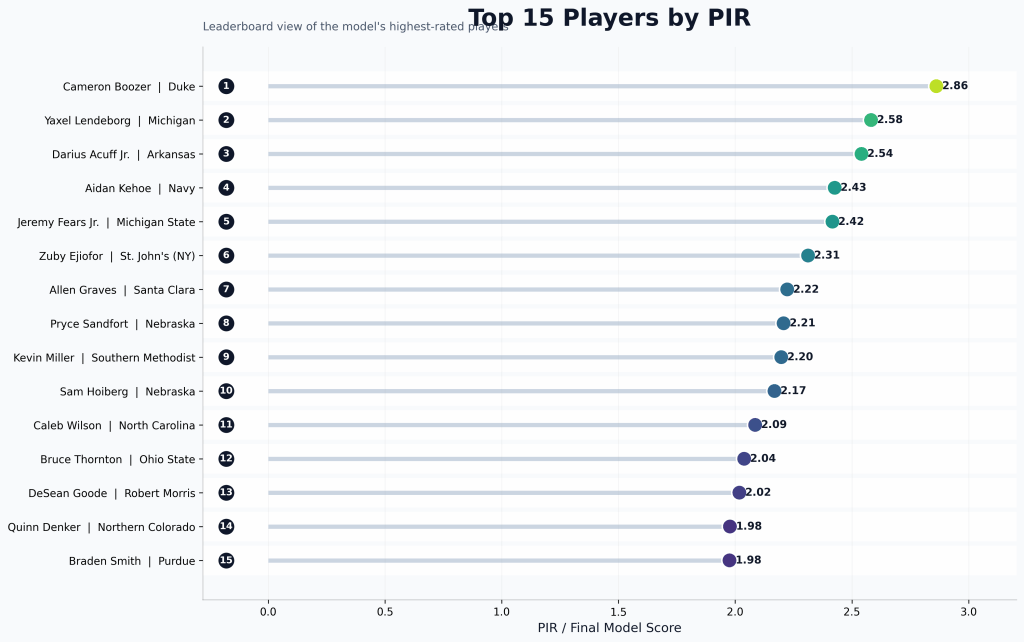
PIR produces a top tier of players who combine efficiency, responsibility, and two-way value. The model’s highest-ranked players include:
- Cameron Boozer
- Yaxel Lendeborg
- Darius Acuff Jr.
- Jeremy Fears Jr.
- Zuby Ejiofor
- Allen Graves
These players stand out not just for production, but for how they generate it — maintaining efficiency while carrying meaningful roles.
Top 15 Players by PIR
Key Takeaways
- The top tier is dominated by players who combine usage + efficiency
- Guards with strong decision-making and playmaking are heavily rewarded
- Bigs who contribute on both ends separate themselves from pure scorers
- The model favors complete offensive profiles over one-dimensional scoring
Understanding Player Archetypes
Beyond rankings, PIR helps categorize how players create value.
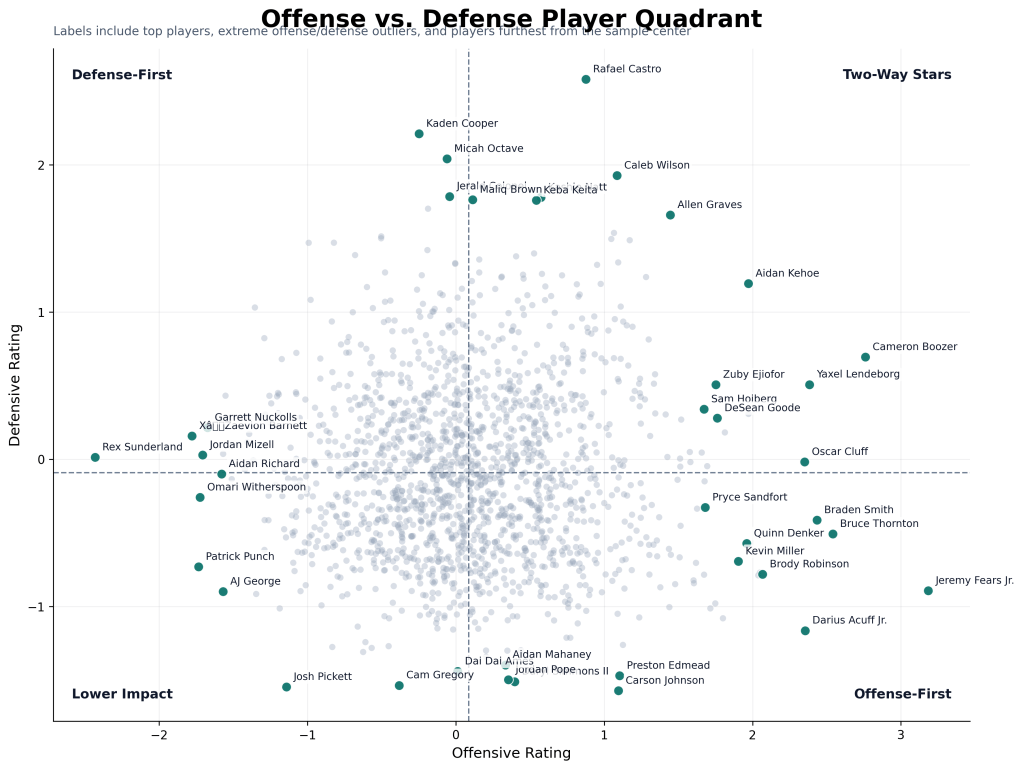
Quadrant Breakdown
- Two-Way Stars (Top Right)
Impact players on both ends of the floor - Offense-First (Bottom Right)
High offensive load, lower defensive impact - Defense-First (Top Left)
Specialists who impact the game defensively - Lower Impact (Bottom Left)
Limited statistical impact or role players
Insights
- Elite players cluster in the two-way quadrant
- The model clearly separates player archetypes
- Some high scorers fall into offense-only profiles, highlighting limitations in overall impact
Applying PIR to the Transfer Portal
The transfer portal is where PIR becomes most actionable.
Rather than asking:
“Who are the best players?”
The model asks:
“Who are the most valuable players available?”
After matching transfer data to the model, PIR produces a ranked transfer board. Top targets include:
- DeSean Goode
- Isaac Celiscar
- Brody Robinson
- Logan Duncomb
- Kyle Evans
- Sananda Fru
These players are identified based on impact profile, not reputation.
Hidden Gems: Model vs. Consensus
To identify undervalued players, PIR is compared against 247Sports transfer rankings, which serve as a proxy for public consensus.
Undervalued Players (Hidden Gems)
These are players where:
PIR rank is significantly higher than 247 ranking
Key examples:
- DeSean Goode
- PIR: #1 transfer target
- 247: #25
→ High-efficiency, high-impact profile undervalued by consensus
- Isaac Celiscar
- PIR: #2
- 247: #36
→ Strong underlying metrics not fully reflected in rankings
- Jalen Cox
- PIR: Top 15
- 247: #71
→ Significant gap driven by production vs visibility
- Jordan Frison
- PIR: Top 15
- 247: #77
- Jack Karasinski
- PIR: Top 20
- 247: #68
- Daniel Freitag
- PIR: Top 25
- 247: #61
These players typically:
- maintain efficiency under real usage
- contribute across multiple statistical areas
- play in lower-visibility environments
Consensus-Favored Players
These are players where:
247 ranking is significantly higher than PIR
Examples:
- Miles Byrd (247 #2, outside PIR Top 25)
- Paulius Murauskas (247 #1, PIR lower tier)
- Kwame Evans Jr. (247 #14, PIR lower ranking)
These players are often valued for:
- projection and upside
- physical tools and archetype
- long-term development potential
What This Comparison Reveals
The differences between PIR and 247 highlight two key insights:
1. PIR Identifies Market Inefficiencies
The model consistently surfaces players with strong impact profiles who are not highly ranked publicly.
2. PIR is Production-Oriented
It values:
- realized performance
- efficiency under load
- two-way contribution
More than:
- projection
- pedigree
- visibility
Case Study: DeSean Goode — A Model-Driven Value Target
Overview
- PIR Transfer Rank: #1
- 247Sports Rank: #25
DeSean Goode represents one of the clearest gaps between model evaluation and public consensus. While consensus views him as a solid transfer, PIR identifies him as the top overall target, signaling potential undervaluation.
Why the Model Is High on Goode
Efficiency Under Responsibility
Goode combines strong efficiency with meaningful offensive involvement.
PIR specifically rewards players who maintain efficiency while carrying real usage, rather than in limited roles.
Multi-Dimensional Offensive Profile
His production is not driven by a single skill. Instead, he contributes across:
- scoring efficiency
- shot selection
- turnover control
This makes his impact more stable and scalable in different systems.
Consistent Impact Across Metrics
Even after blending external metrics (BPR, BPM), Goode remains near the top of the board.
This suggests his profile is not model-specific — it is broadly supported by impact data.
Why Consensus Is Lower
The gap between PIR and 247 likely reflects differences in evaluation priorities:
- Visibility: Lower-profile players receive less attention
- Projection: Rankings often prioritize upside over current production
- Archetype Bias: Certain player types are valued more heavily in recruiting rankings
PIR, by contrast, is focused on realized impact, not projection.
What This Means
Goode fits the profile of a high-floor, undervalued contributor:
- efficient within role
- scalable offensive impact
- lower risk than projection-heavy players
These are the types of players who often outperform their market ranking.
Takeaway
DeSean Goode highlights the core strength of PIR:
Identifying players whose underlying impact exceeds their public perception.
In a transfer-driven landscape, finding players like this can create a meaningful competitive advantage.
Strengths of PIR
- Balances efficiency and usage
- Separates offense and defense
- Uses external metrics for stability
- Identifies undervalued players
- Directly applicable to transfer portal decisions
Limitations
- Defense remains difficult to fully capture statistically
- One-season data can introduce variance (especially shooting)
- Model does not fully account for long-term projection or physical upside
Conclusion
Player Impact Rating (PIR) is designed to function as a decision-making tool, not just a ranking system.
It provides a structured way to:
- evaluate player impact
- understand player roles
- identify undervalued talent
- analyze differences between model-driven and consensus evaluations
In a transfer-driven environment, where identifying value is critical, PIR helps answer the question:
Not just who is good — but who is being undervalued.
Thanks for reading!
By, Armaan Sharma
 Armaan Sharma