
Section Overview
This project explores how offensive responsibility, efficiency, and defensive activity interact at the college level to surface NBA draft prospects who may be undervalued by traditional box-score evaluation. Rather than ranking players outright, the analysis focuses on identifying role archetypes and statistical signals that warrant deeper scouting attention. Custom metrics are used to contextualize efficiency relative to role and decision-making load, while defensive event rates serve as screening tools for defensive activity. The goal is not projection in isolation, but structured discovery that can guide film study and player evaluation.
Offensive Framework
Offensive production is often evaluated without accounting for how much decision-making responsibility a player carries. To address this, the offensive framework separates efficiency from role by adjusting scoring efficiency for usage and minutes, and pairs it with a measure of decision load. Together, these metrics help distinguish efficient creators, finishers, and players whose roles may not translate cleanly to higher levels.
The two custom offensive metrics:
RAE (Responsibility-Adjusted Efficiency): Measures scoring efficiency relative to offensive responsibility, controlling for usage and minutes.
TS%i=α+β⋅USG%i+εi
DLR (Decision Load Ratio): Captures how frequently a player creates for others relative to how often they use possessions.
RAE vs DLR Visualization (Efficency vs Decision Load)
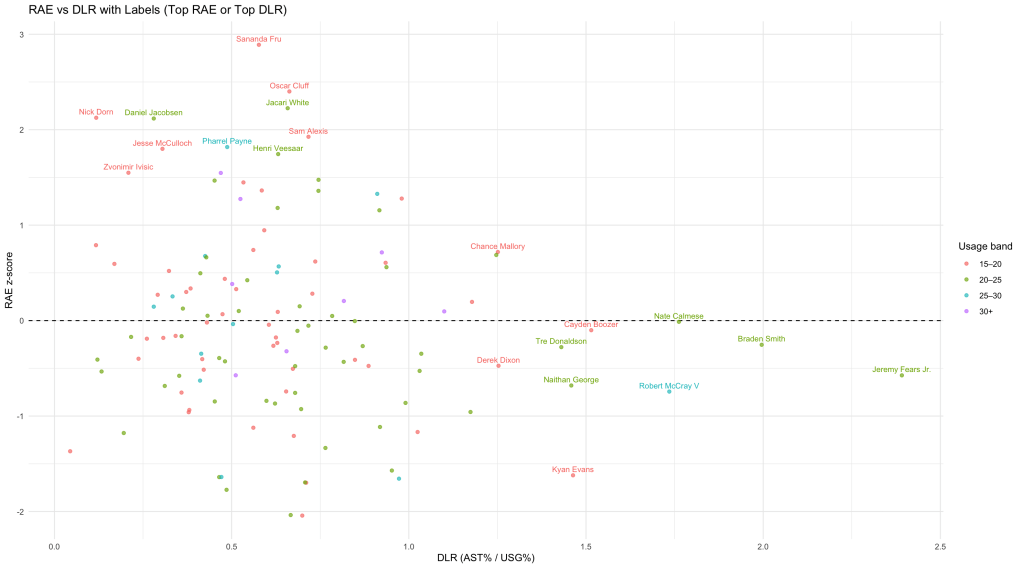
The RAE–DLR scatter categorizes players by how efficiently they convert offensive responsibility and how that responsibility is expressed. Players in the upper-right quadrant combine efficiency with decision-making and tend to scale well into higher-level offensive roles. High-efficiency, low-DLR players often thrive as finishers, while high-DLR, low-efficiency profiles may reflect overextended roles that require contextual film evaluation.
Guards:
Guards in this group are evaluated primarily on how efficiently they convert offensive responsibility and how that responsibility is expressed through decision-making. RAE provides context for efficiency under load, while DLR helps distinguish primary creators from scoring-focused guards.
| Player | School | Usage | TS | RAE (z) | DLR |
|---|---|---|---|---|---|
| Jacari White | Virginia | 23.7 | .697 | 2.23 | 0.658 |
| Bruce Thornton | Ohio State | 22.9 | .684 | 1.16 | 0.917 |
| Markus Burton | Notre Dame | 31.5 | .594 | 0.714 | 0.924 |
| Tayton Conerway | Indiana | 23.5 | .629 | 0.688 | 1.25 |
| Keaton Wagler | Illinois | 22.2 | .633 | 0.560 | 0.937 |
| Lamar Wilkerson | Indiana | 27.7 | .620 | 0.505 | 0.628 |
| Fletcher Loyer | Purdue | 22.1 | .623 | 0.496 | 0.412 |
| Ryan Conwell | Louisville | 30.7 | .593 | 0.383 | 0.502 |
| Nick Boyd | Wisconsin | 31.1 | .586 | 0.206 | 0.817 |
Forwards:
Forwards often occupy hybrid offensive roles, making RAE particularly useful for separating efficiency from usage. DLR provides additional context on whether production comes from advantage creation, connective play, or finishing within structure.
| Player | School | Usage | TS | RAE (z) | DLR |
|---|---|---|---|---|---|
| Pharrel Payne | Maryland | 28.1 | .670 | 1.82 | 0.488 |
| Henri Veesaar | North Carolina | 21.7 | .713 | 1.74 | 0.631 |
| Donnie Freeman | Syracuse | 31.1 | .635 | 1.55 | 0.469 |
| RJ Godfrey | Clemson | 21.2 | .685 | 1.48 | 0.745 |
| Jaxon Kohler | Michigan State | 20.8 | .690 | 1.47 | 0.452 |
| Cameron Boozer | Duke | 29.2 | .672 | 1.33 | 0.911 |
| Malik Reneau | Miami (FL) | 32.2 | .648 | 1.27 | 0.525 |
| Reed Bailey | Indiana | 20.8 | .653 | 1.18 | 0.630 |
| Thijs De Ridder | Virginia | 26.8 | .622 | 0.677 | 0.425 |
| Caleb Wilson | North Carolina | 28.6 | .619 | 0.567 | 0.633 |
| Shelton Henderson | Miami (FL) | 21.5 | .618 | 0.423 | 0.544 |
| Juke Harris | Wake Forest | 28.2 | .607 | 0.254 | 0.333 |
Centers:
Centers are evaluated differently due to lower average usage and decision load. In this context, RAE highlights efficiency relative to touches, while DLR helps identify bigs capable of making reads rather than functioning solely as finishers.
| Player | School | Usage | TS | RAE (z) | DLR |
|---|---|---|---|---|---|
| Daniel Jacobsen | Purdue | 21.4 | .702 | 2.12 | 0.280 |
| Patrick Ngongba | Duke | 20.0 | .674 | 1.36 | 0.745 |
| Tomislav Ivisic | Illinois | 20.3 | .615 | 0.663 | 0.429 |
| Trey Kaufman-Renn | Purdue | 23.7 | .586 | 0.150 | 0.692 |
Defensive Framework
Defensive impact is difficult to quantify using public data alone. Rather than attempting to measure total defensive value, this project uses defensive event rates as screening tools to identify players who consistently generate disruptive actions. These signals are intended to guide film study rather than serve as definitive evaluations.
The custom metric used:
DER (Defensive Event Rate): Sum of steal percentage and block percentage, capturing defensive activity and disruption.
DER Visuals
DER by Position
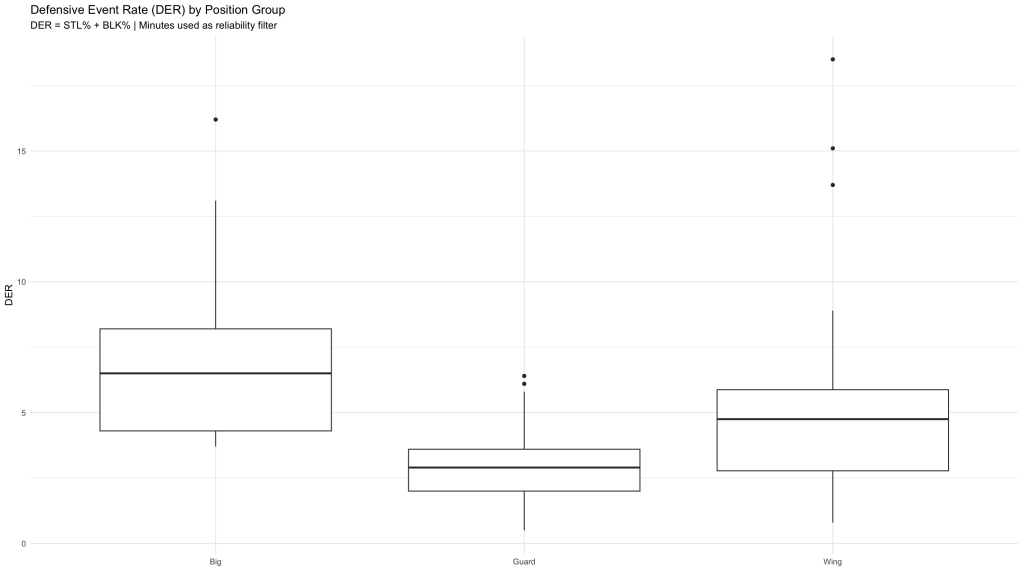
Defensive activity manifests differently by role. Guards generate events primarily through steals, bigs through rim protection, and wings through a mix of both. This distribution highlights why DER is used as a screening metric within positional context rather than a standalone measure of defensive impact.
While the distribution above provides positional context, the following visualization decomposes defensive event creation to illustrate how individual players generate their DER values.
Top DER Players
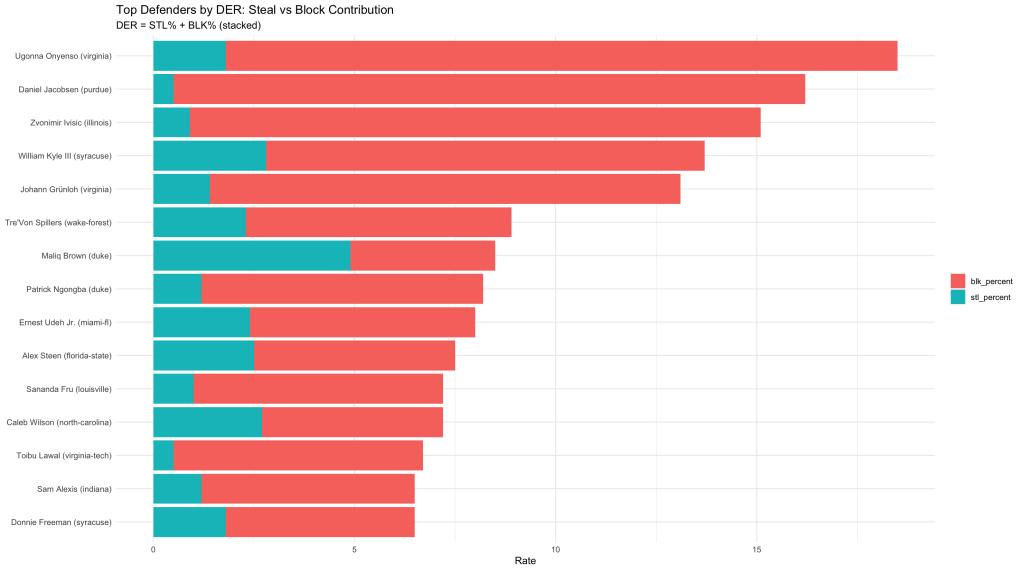
Although players may post similar DER values, the composition of those events varies substantially. Some profiles are driven by block rates indicative of rim protection, while others reflect perimeter disruption through steals. This distinction is critical for scouting, as defensive value is role- and scheme-dependent. Film evaluation is therefore used to contextualize whether these events translate to sustainable defensive impact.
Defensive Discovery List
Guards:
Guards in this group surface primarily through steal-driven defensive activity, highlighting perimeter disruption and anticipation rather than interior deterrence.
| Player | School | Usage | DER (z) | STL% | BLK% |
|---|---|---|---|---|---|
| Lajae Jones | Florida | 19.8 | 0.752 | 2.6 | 0.1 |
| Isaiah Evans | Duke | 24.0 | 0.650 | 1.9 | 0.1 |
| Chance Mallory | Virginia | 19.5 | 0.548 | 5.0 | 0.0 |
Forwards
Forwards generate defensive value through a combination of off-ball disruption and secondary rim protection, with DER profiles often reflecting versatility rather than specialization.
| Player | School | Usage | DER (z) | STL% | BLK% |
|---|---|---|---|---|---|
| Ugonna Onyenso | Virginia | 17.5 | 4.86 | 1.8 | 3.1 |
| Zvonimir Ivišić | Illinois | 18.2 | 3.70 | 0.9 | 2.8 |
| William Kyle III | Syracuse | 16.4 | 3.23 | 2.8 | 0.4 |
| Tre’Von Spillers | Wake Forest | 19.2 | 1.60 | 2.3 | 0.2 |
| Alex Steen | Florida State | 17.7 | 1.13 | 2.5 | 0.1 |
| Caleb Wilson | North Carolina | 28.6 | 1.02 | 2.7 | 0.1 |
| Sananda Fru | Louisville | 18.2 | 1.02 | 1.0 | 0.6 |
| Toibu Lawal | Virginia Tech | 19.5 | 0.854 | 0.5 | 0.4 |
| Donnie Freeman | Syracuse | 31.1 | 0.786 | 1.8 | 0.2 |
| Sam Alexis | Indiana | 16.6 | 0.786 | 1.2 | 0.4 |
| Jaxon Kohler | Michigan State | 20.8 | 0.718 | 1.6 | 0.3 |
| Coen Carr | Michigan | 22.1 | 0.718 | 1.6 | 0.3 |
| Amani Hansberry | Virginia | 24.3 | 0.582 | 2.8 | 0.1 |
| Malik Reneau | Miami (FL) | 32.2 | 0.548 | 1.4 | 0.2 |
| Cameron Boozer | Duke | 29.2 | 0.514 | 3.2 | 0.1 |
| Sadiq White Jr. | Syracuse | 21.3 | 0.514 | 2.2 | 0.1 |
| Nolan Winter | Wisconsin | 18.8 | 0.514 | 1.3 | 0.2 |
Centers
Centers surface through block-driven defensive event rates, with steal percentages providing secondary signal for mobility and scheme versatility.
| Player | School | Usage | DER (z) | STL% | BLK% |
|---|---|---|---|---|---|
| Daniel Jacobsen | Purdue | 21.4 | 4.08 | 0.5 | 3.6 |
| Johann Grünloh | Virginia | 17.5 | 3.03 | 1.4 | 1.6 |
| Patrick Ngongba | Duke | 20.0 | 1.36 | 1.2 | 0.2 |
| Carson Cooper | Michigan | 19.3 | 0.786 | 1.3 | 0.2 |
| Carter Collins | Clemson | 25.4 | 0.752 | 2.9 | 0.1 |
PLAYER SPOTLIGHTS

Ryan Conwell — (Senior, Louisville)
Profile Snapshot
- Position: Guard (Combo/Scoring Guard)
- Height/Weight: ~6’4”, 215 lbs — strong, compact build with good functional strength.
- Age / Experience: Senior, four-school trajectory: South Florida → Indiana State → Xavier → Louisville.
2025-26 Performance Metrics
- Scoring: ~19.9 PPG, one of Louisville’s offensive focal points.
- Rebounding / Playmaking: ~4.9 RPG, ~2.3 APG — shows activity on the glass for a guard and secondary creation.
- Efficiency: ~40.8% FG and high volume three-point marks; FT shooting around low-80s.
- Advanced Metrics Context: Conwell scores efficiently and keeps turnovers manageable for his volume. ( RAE .593, DLR .383, .502 suggests good responsibility adjusted to efficiency)
Conwell has flashed impact scoring nights (e.g., 32 points, 8 threes vs. NJIT) and consistently draws defensive attention as Louisville’s primary offensive option.
Strengths
Scoring & Shooting
- High-level shooter: Efficient from three both off the catch and rhythm looks; smooth release and range.
- Volume scorer: Capable of creating his own shot and sustaining scoring runs — a go-to bucket getter.
- Versatility: Scoring off the dribble, pull-ups, and spot-up work; can stretch defenses.
Physical Profile & Intangibles
- Solid size & strength: At 6’4”, 215 with a strong base, Conwell can absorb contact and finish over length.
- Activity: Rebounds at a high rate for a guard and competes physically in traffic.
- Experience: Multiple systems and leagues — adaptability and leadership maturity.
Situational Impact
- Team focal point: Louisville leans on him as a primary creator, especially with other stars injured at points this season.
- Clutch ability: Trusted in late-game possessions and mid-range scoring zones.
Areas for Development
Creation vs. Pro Defense
- While a strong scorer, creating high-efficiency offense against pro-level defenders remains a question — can he consistently break down length at the next level?
Shot Selection & Consistency
- Off-the-dribble shooting shows variance — better as a catch-and-shoot specialist than as an off-screen creator.
Playmaking
- Facilitating is competent but not elite — assist numbers are modest relative to usage, suggesting his best role may be as a secondary creator rather than a primary point guard.
Player Style & Comparison
Player Archetype:
Conwell profiles as a scoring combo guard — strong isolation scorer, reliable from distance, and capable of attacking closeouts. Not a traditional pass-first point guard, but a high-usage wing with scoring instincts.
NBA/Next Level Fit:
- 3&D wing with scoring tilt: Could slot as a 2-guard who spaces the floor and creators offense off pull-ups and drives.
- Secondary ball-handler: Good fit next to a true point guard who initiates, letting Conwell read and react.
- Rotation upside: Best immediate impact as a bench scoring spark or spot starter with offensive freedom.
- Defensive projection: Remains a work in progress — strength helps, but lateral quickness vs elite wings will be tested.
Draft / Evaluation Outlook:
Scouts see him as an underrated scoring guard with strong shooting traits and a competitive mentality (NBA Draft analysts have highlighted his consistency and shooting profile).
Summary Evaluation
Ryan Conwell is a mature, high-usage scoring guard with legitimate shooting chops, physical strength, and composure in tough spots. His statistical profile — strong points per possession, rebounding activity for size, and shot creation — makes him a valuable offensive engine on a collegiate roster and a legitimate candidate for rotational impact in pro systems that value scoring wings. Continued refinement in creation and defense will determine his draft ceiling, but his productivity, versatility, and competitive scoring translate well to front office projections.

Shelton Henderson — Miami (FL)
Position: Forward / Wing
Class: Freshman (2025–26)
Size: 6’6”, 240 lbs
Advanced Metrics
- Usage: 21.5
- TS%: .618
- RAE: 0.423
- DLR: 0.544
Interpretation: Henderson isn’t a low-usage “finisher” riding efficiency—he’s carrying real offensive involvement and staying efficient. The combination of positive RAE (efficiency relative to responsibility) and a strong DLR (decision load/creation layer) is exactly the signature of a player whose value typically outpaces public perception early.
Executive Summary
Henderson profiles as a physically NBA-ready freshman wing whose early on-court impact and underlying “responsibility + efficiency” indicators suggest a higher long-term ceiling than his current draft-market visibility. He’s not showing up consistently in mocks largely because he projects as a likely multi-year college player, but the ingredients teams prioritize for early tracking—frame, functional athleticism, competitiveness, and scalable role utility—are all present.
Strengths
1) NBA Frame + Functional Physicality
Henderson is already built like a pro wing/forward. Recruiting evaluators consistently emphasize his powerful build, length, and athletic tools—traits that translate cleanly to defensive versatility and contact scoring at the next level.
2) Efficient Production Base (Not “Empty” Efficiency)
Your TS% and RAE flags align with what teams want from young forwards: value creation without breaking possessions. For freshman wings, early efficiency is often role-protected; Henderson’s profile (via usage + RAE) points to real offensive value even before the full perimeter game arrives.
3) Decision Load / Connector Upside
DLR = 0.544 supports the idea that he’s not purely a play-finisher—he’s being asked to read, attack advantage, and keep the ball moving. That matters for projecting him into NBA ecosystems where wings must function as connectors, secondary drivers, and short-roll/advantage passers.
4) Winning and High-Level Experience Signals
Gold medal experience with USA Basketball (and documented productivity in that environment) is a meaningful “competitive baseline” indicator for projection models and scouting rooms.
Development Priorities (What will swing his outcome)
Perimeter Shooting (Spacing Gravity)
The primary swing skill is becoming a consistent perimeter threat. Until the jumper stabilizes, his NBA role projects more as defense/physicality + transition/paint pressure + connective play than true 3-level wing creation.
Handle/Creation vs Set Defenses
He has flashes as an attacker, but expanding his handle package and improving efficiency against set NBA defenses will determine whether he becomes a high-end role wing or grows into a bigger-usage initiator archetype.
Defensive Detail (Technique to Match Tools)
The tools suggest switchability; the next step is stacking consistent possessions: screen navigation, closeout control, and off-ball positioning. The body is already there—now it’s reps and discipline.
Why He’s Better Than Current Public Perception
Henderson’s muted mock-draft presence reads more like timeline bias than talent. Media boards overweight “ready now” skill profiles and underweight freshmen wings who are (1) likely to return and (2) still rounding out shooting. NBA teams, by contrast, actively track prospects who combine pedigree + frame + early role competence, because those players often make the biggest Year-2/Year-3 leaps.
Put simply: he’s a “track early” asset, not a “rank today” player.
NBA Role Projection
Archetype: Two-way developmental wing/forward (physical driver/finisher + defensive versatility + connector upside)
Best-fit usage: Next to a primary initiator where he can attack closeouts, run in transition, defend multiple positions, and grow into more on-ball reps.
Draft-cycle expectation: More likely a future cycle riser than a “this-year mock staple,” with real breakout potential if shooting and defensive consistency trend upward.
Bottom Line (Project Statement)
Shelton Henderson is an undervalued developmental wing whose responsibility-adjusted efficiency and decision-load profile support a higher internal grade than public draft discourse currently reflects. His size, pedigree (Top-25 recruit), and USA Basketball winning reps provide a strong foundation for a second-year leap and eventual NBA role viability.

Daniel Jacobsen — Purdue
Position: Center
Class: Freshman
Size: ~7’3”–7’4”, elite length and standing reach
Role Context: Rotation big with rapid impact minutes
Evaluation Lens: Undervalued defensive anchor with extreme efficiency signals
Custom Metrics Snapshot
Offensive / Decision Context
- Usage: 21.4
- TS%: .702
- RAE: 2.12
- DLR: 0.280
Defensive Impact
- DER (z): 4.08
- STL%: 0.5
- BLK%: 3.6
Immediate takeaway:
Jacobsen is producing elite responsibility-adjusted efficiency and grading as a top-tier defensive impact player by DER. That combination is extremely rare for a freshman center — and strongly suggests his current public perception understates his value.
Executive Summary
Daniel Jacobsen profiles as a high-leverage interior defender and ultra-efficient offensive finisher whose impact metrics already resemble those of established high-major starting centers. While his role is not yet heavy-minutes dominant, his RAE (2.12) and DER (4.08 z-score) indicate that when he is on the floor, he meaningfully tilts outcomes on both ends.
He is best described as a “quietly dominant” freshman big — the type of player front offices track aggressively even when draft media has not caught up.
Strengths
1. Extreme Responsibility-Adjusted Efficiency (RAE = 2.12)
- This is the headline signal.
- A 2.12 RAE at 21.4 usage places Jacobsen in an elite efficiency band, even after controlling for role.
- Indicates:
- Excellent shot selection
- Reliable finishing
- Zero offensive noise or possession drag
This is not “low-usage big efficiency.” This is value-added efficiency.
2. Interior Defensive Anchor (DER z = 4.08)
- A 4.08 DER z-score puts Jacobsen in rare territory among college bigs.
- Reflects:
- Strong rim deterrence
- Vertical contest reliability
- Defensive possessions ending cleanly
His 3.6 BLK% reinforces the film expectation: he changes shots even when he doesn’t block them.
3. Size-Based Structural Advantage
- Legitimate 7’4” scale creates:
- Automatic rim gravity on offense
- Built-in defensive margin for error
- Purdue’s system historically maximizes skilled bigs; Jacobsen already looks comfortable within structured coverage and spacing rules.
4. Offensive Role Discipline (DLR = 0.280)
- Lower DLR is a positive in this context.
- Indicates:
- He is not forcing reads or over-handling
- Offensive value comes from screening, finishing, sealing, and rim pressure
- This is exactly what NBA teams want from young centers early in their development curve.
Areas for Development (Projection-Oriented, Not Red Flags)
Expanded Decision Load
- DLR suggests limited passing responsibility.
- Next steps:
- Short-roll reads
- Kick-outs vs tags
- Processing speed under pressure
This is developmental, not limiting — especially for a freshman center.
Mobility vs NBA Spacing
- Foot speed and perimeter recovery will determine:
- Drop-only vs mixed coverage viability
- Playoff-level defensive scalability
- Purdue system masks some of this; NBA evaluation will focus heavily here.
Foul Management / Physical Endurance
- Common freshman-big issues.
- Not a concern long-term, but affects minute stability early.
Why He’s Better Than Current Public Perception
Jacobsen is under-discussed because:
- He’s a freshman center (slowest position for public hype)
- His value is impact-driven, not highlight-driven
- He’s likely viewed as a multi-year college player
Front offices think differently:
Elite defensive signal + elite efficiency + size = early tracking priority.
Players with this DER + RAE combination often jump tiers rapidly once minutes scale.
NBA Role Projection
Archetype:
Interior defensive anchor / vertical spacer / efficiency big
Early NBA Role:
- Backup center who stabilizes lineups
- Rim protection, screen-and-dive, low-mistake offensive profile
Upside Outcome:
- Starting-caliber drop big with matchup-specific defensive value
- High on/off impact without usage demand
Draft Cycle Outlook:
- Likely returns to school
- Strong candidate for Year-2 / Year-3 draft surge
- Internal boards will be meaningfully higher than mocks
Final Evaluation (Project Thesis Statement)
Daniel Jacobsen is materially undervalued by public draft discourse.
His 2.12 RAE confirms elite efficiency at real usage, while his 4.08 DER z-score signals top-tier defensive impact. Combined with rare size and role discipline, Jacobsen profiles as the type of center NBA teams prioritize early — not because he’s flashy, but because he reliably raises lineup floor.
This is exactly the profile your project is designed to surface.
Git : https://github.com/ArmaanSharmas/draft-model.git
Thank you for reading!
By, Armaan Sharma
 Armaan Sharma